The authors are involved in building MEDKAP, KAPSLY, and the Healthechpark. This article describes the rationale behind that work.
Hospitals need Innovation Strategies
Hospitals that take a proactive approach to digitalisation and networking will gain an edge in integrated healthcare. The available technological possibilities promise not only a more efficient healthcare system but also one that prioritises patient benefits. The Board of Directors is responsible for ensuring that innovation, with defined objectives and actionable measures, becomes an integral part of the hospital’s future-oriented strategy.
The healthcare industry is undergoing such rapid technological innovation that it will transform beyond recognition within a few years. If the digitalisation of medicine and healthcare providers succeeds, it will bring substantial benefits for both patients and service providers. However, this path holds numerous challenges, especially for hospitals. Merely being a passive institution that bills according to fixed rates and is passive towards change is inadequate for the future. Instead, hospitals must proactively confront these challenges.
Hospitals face a myriad of challenges: they need to prepare their employees for future changes on a professional and personal level. They must evolve into innovation platforms, where new therapies and treatments are collaboratively developed, tested, and implemented with educational institutions and start-ups. Hospitals and their representatives must also function as think tanks, contributing to discussions and influencing change.
Establishing a Health Innovation Hub
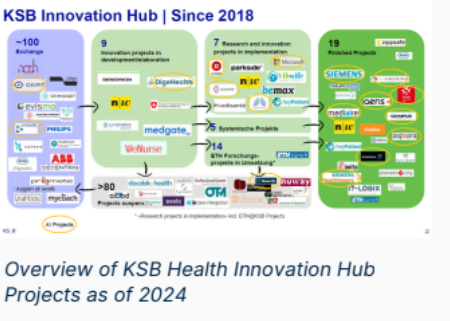
For the 2017–2023 strategy cycle, the Board of Directors of Kantonsspital Baden (KSB), at the request of the Executive Board, defined innovation as a strategic priority and established the KSB Health Innovation Hub in 2018. Equipped with a dedicated innovation manager and a structured budget framework, the Hub introduced professional innovation governance into the organisation.
The results demonstrate the effectiveness of this approach. By 2025, 19 projects had been successfully executed. At the same time, 28 innovation projects were ongoing and nine new initiatives were launched. Discussions were held with more than 100 innovative companies, including PSI and USZ. Two start-ups, Nuclidium and Hey Patient, received investments. Importantly, over 80 projects were deliberately discontinued due to the absence of a sustainable win-win scenario. Innovation was not treated as enthusiasm, but as disciplined portfolio management. Other hospitals, including USZ, adopted similar approaches.
The key insight was clear: innovation requires structure, governance and long-term commitment.
2025: Founding Health Innovation Hub Aargau
In 2025, KSB, Kantonsspital Aarau (KSA), the City of Baden and the Canton of Aargau institutionalised their joint innovation ambitions by founding the Health Innovation Hub Aargau. The objective was not to create another initiative, but to elevate innovation from a single-hospital programme to a coordinated cantonal framework.
Building on the operational experience of the KSB Health Innovation Hub and the research strength of KSA, innovation was aligned across institutions. Clinical expertise, research capacity and entrepreneurial activity were brought together within one structured platform.
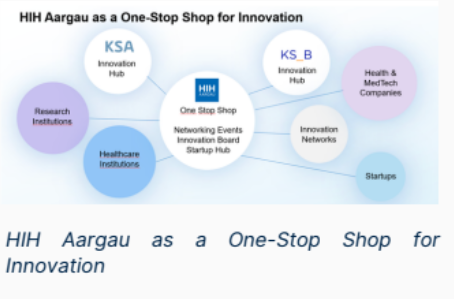
HIH Aargau functions as a central interface within the regional healthcare innovation ecosystem. It connects hospitals, research institutions, startups, established Health and MedTech companies and innovation networks within a coordinated framework.
Through structured networking formats, curated exchange and joint initiatives, the Hub reduces fragmentation and increases transparency across innovation activities. The Innovation Board enables strategic prioritisation and informed decision-making, while the Startup Hub and proximity to clinical environments allow solutions to be tested and validated under real-world conditions.
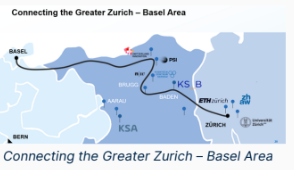
The objective is clear: to accelerate translation from technological development to clinical application, strengthen the regional Health and MedTech ecosystem and position Aargau within the Greater Zurich–Basel innovation corridor as a leading location for healthcare innovation.
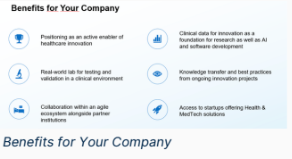
Elements of an Action Oriented Innovation Strategy
An effective innovation strategy begins with systematic monitoring. Hospitals must remain closely attuned to technological, regulatory and therapeutic developments in order to anticipate change rather than react to it. Being “on the pulse” is not a metaphor, but a structured process that enables informed and timely decision-making.
Equally essential is the creation of platforms that connect clinical practice with research institutions and innovative companies. Hospitals must offer environments in which new ideas can be assessed, tested and further developed under realistic clinical conditions. Without such translational spaces, innovation remains theoretical.
However, collaboration alone is insufficient. Innovation requires governance. External partners must be identified deliberately, projects must be evaluated rigorously, and potential mutual benefit must be assessed objectively. This demands continuity in leadership and professional innovation management over time.
Finally, innovation must be embedded in organisational culture. Leadership must actively promote innovative behaviour, create appropriate incentives and communicate achievements transparently. Only when innovation becomes part of the institution’s identity does it evolve from isolated initiatives into a sustainable strategic capability.
Collaborating with Research Centers / Universities Pioneering the Hospital of the Future
Technological change will influence virtually all hospital processes, from diagnostics and medical procedures to logistics, administration and management. Institutions that anticipate these developments can design future-ready infrastructure and processes accordingly. KSB has already integrated innovation considerations into its new hospital building.
Close collaboration with universities and research centres further strengthens translational capacity. The ETH@KSB partnership exemplifies this approach. Joint research initiatives, clinical data access and physical proximity in Partner House II foster rapid exchange and interdisciplinary cooperation. Such structures shorten communication lines and accelerate innovation cycles.
Promoting Innovation in the Medical and HealthTech Sector
Structured innovation governance also enables targeted collaboration with the MedTech industry. Over multi-year pilot phases, new technologies can be developed and validated within clinical settings. This strengthens both healthcare quality and regional value creation.
Regions such as Basel and Baden demonstrate that coordinated innovation strategies between hospitals and industry increase economic impact and attract
investment. Aligning hospital initiatives with cantonal and national innovation programmes fosters durable ecosystems that connect industry, research and clinical practice.
Early adoption, however, must remain aligned with patient safety and quality standards. Innovation is not an end in itself. It must serve patients and improve system performance.
A Blueprint for Institutionalised Innovation
The experience of Kantonsspital Baden and the Health Innovation Hub Aargau illustrates a broader principle. Innovation in healthcare cannot be improvised. It must be governed, resourced and structurally anchored at Board level.
Institutionalised innovation creates transparency, accelerates translation and strengthens regional competitiveness. It transforms innovation from sporadic experimentation into a strategic capability. Hospitals that build such structures will shape the future of healthcare. Those that do not will adapt to it.
Closing Remark
Switzerland offers many of the right ingredients: talent, funding, IP strength and regulatory clarity. Yet capitalizing on this moment will take more than favorable trends. Angels, VCs, corporates and public actors must work together to turn scientific and entrepreneurial promise into companies that scale – and stay. The window is open.
If you want to stay updated on Angel Investing in HealthTech at MEDKAP, please
- subscribe to our newsletter
- subscribe to our LinkedIn page
About the author
Dr. Daniel Heller: Daniel is the Chairman of the Board of Directors of KSB, which was presumably the first hospital in Switzerland to deliberately invite startups to bring innovation to hospitals. Furthermore, he is Partner at Farner Consulting, where he heads the Head Startup Desk; as Chairman of the Board he presides over, among others, the Kantonsspital Baden, which stands out with its Health Innovation Hub and its perfomance as an economically successful public hospital.